Welcome to EVKafka
Handle kafka events made easy.
EVKafka is a lightweight framework for building event-driven microservices with Apache Kafka and Python. It is based on the asynchronous Kafka client library aiokafka.
Focus on event handling while the framework takes care of the rest.
Features
- Easy to start and use
- Sync/async handlers are supported
- Extensible through consumer middleware
- Lifespan
- At-Least-Once/At-Most-Once event delivery guarantees
- Automatic API documentation generation
Installation
$ pip install evkafka
Introduction
Build a consumer app
A simplest possible consumer app may look like this:
from evkafka import EVKafkaApp, Handler
from evkafka.config import ConsumerConfig, BrokerConfig
from pydantic import BaseModel


handler = Handler()


class FooEventPayload(BaseModel):
    user_name: str


@handler.event("FooEvent")
async def foo_handler(event: FooEventPayload) -> None:
    print('Received FooEvent', event)


if __name__ == "__main__":
    broker_config: BrokerConfig = {
        "bootstrap_servers": "kafka:9092"
    }

    consumer_config: ConsumerConfig = {
        "group_id": "test",
        "topics": ["topic"],
        **broker_config
    }

    app = EVKafkaApp(expose_asyncapi=True)
    app.add_consumer(consumer_config, handler)
    app.run()
The application connects to the Kafka broker and begins
reading kafka messages. Once a message of type FooEvent
is received, the app calls the foo_handler handler function,
passing the message object as the event parameter.
Note. Kafka broker should be available at
kafka:9092to run the example.
Explore API documentation
Automatic documentation (based on AsyncAPI) is build and served at
http://localhost:8080.
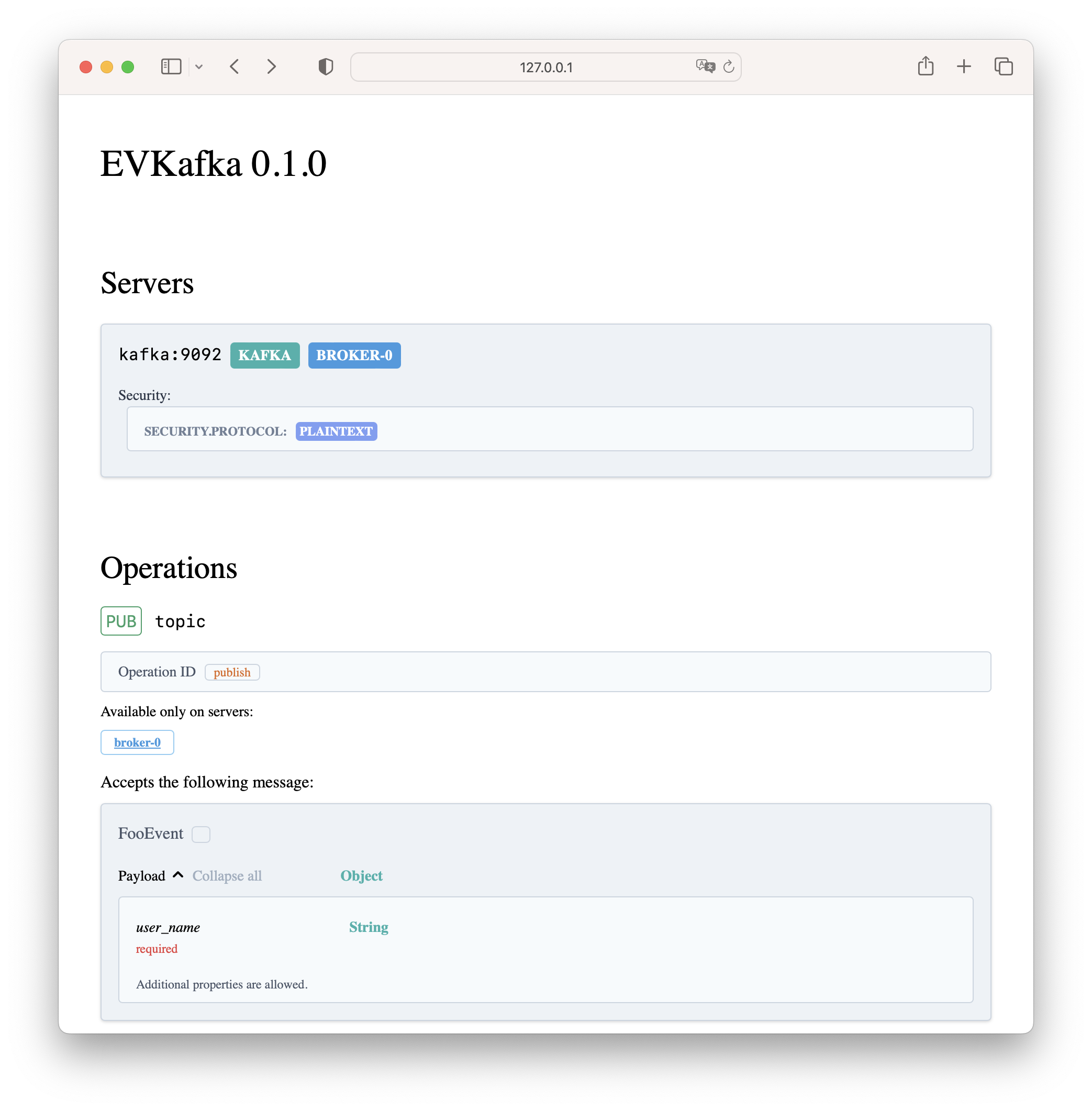
In our example, the topic is represented as a channel
in the documentation. AsyncAPI describes the application
from a client perspective, specifying that the application
expects FooEvent to be published to the channel.
Add another event
It worth nothing to add another handler function to process different message type:
class BarEventPayload(BaseModel):
    user_name: str
    message: str


@handler.event('BarEvent')
async def bar_handler(event: BarEventPayload) -> None:
    print(event)
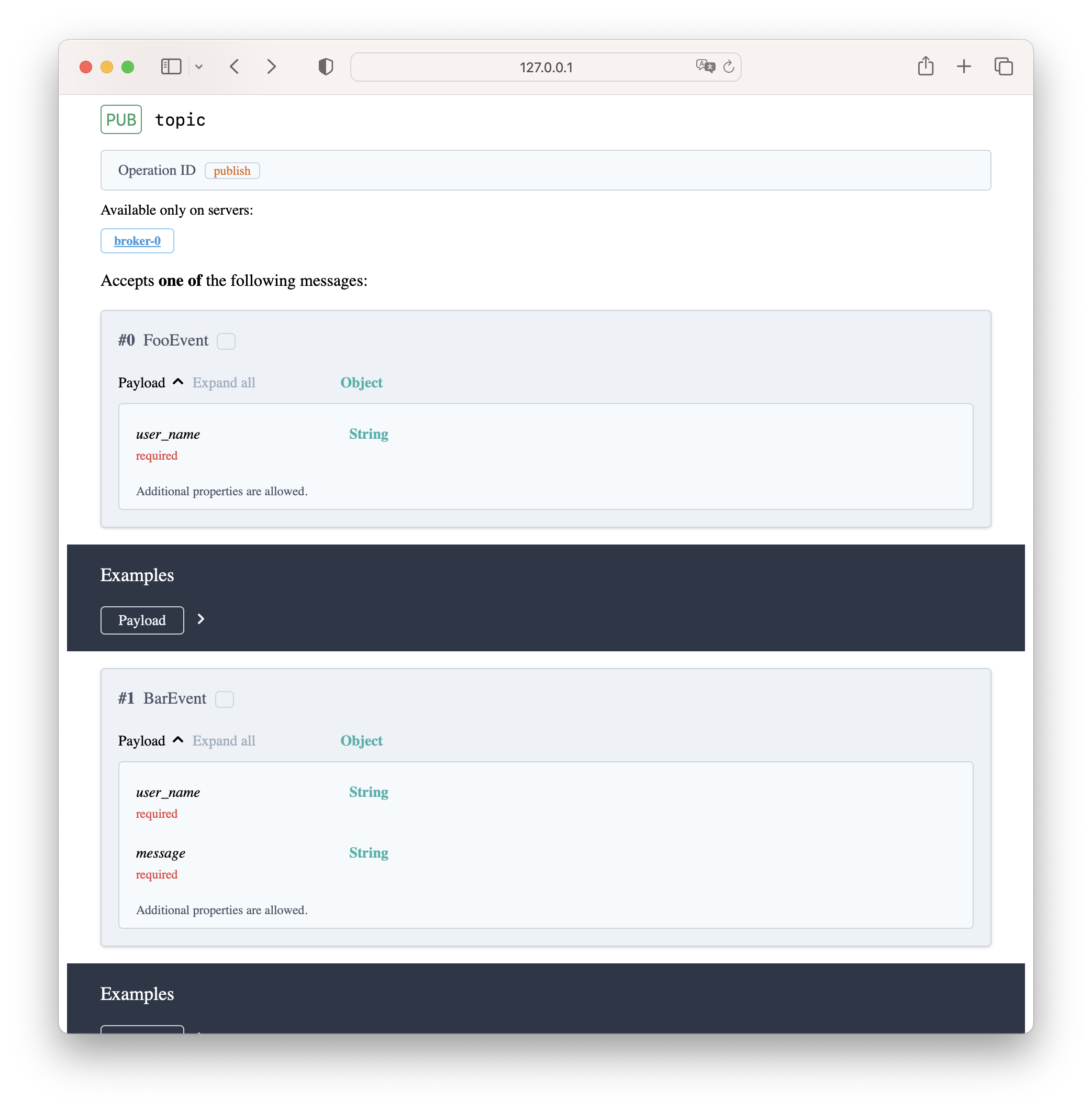
Check documentation update
Restart your app. You should see updated docs:
Produce events with EVKafka
A producer may be instantiated within the app and used to produce new events:
from evkafka import EVKafkaApp, Handler, Request, Sender
from evkafka.config import ConsumerConfig, BrokerConfig, ProducerConfig
from pydantic import BaseModel


sender = Sender()
handler = Handler()


class FooEventPayload(BaseModel):
    user_name: str


class BarEventPayload(BaseModel):
    user_name: str
    message: str


@sender.event('BarEvent')
async def send_bar(event: BarEventPayload) -> None:
    pass


@handler.event("FooEvent")
async def foo_handler(event: FooEventPayload) -> None:
    print('Received FooEvent', event)
    new_event = BarEventPayload(user_name=event.user_name, message='hello')
    await send_bar(new_event)


@handler.event("BarEvent")
async def bar_handler(event: BarEventPayload) -> None:
    print('Received BarEvent', event)


if __name__ == "__main__":
    broker_config: BrokerConfig = {
        "bootstrap_servers": "kafka:9092"
    }

    consumer_config: ConsumerConfig = {
        "group_id": "test",
        "topics": ["topic"],
        **broker_config
    }

    producer_config: ProducerConfig = {
        "topic": "topic",
        **broker_config
    }

    app = EVKafkaApp(expose_asyncapi=True)
    app.add_consumer(consumer_config, handler)
    app.add_producer(producer_config, sender)
    app.run()
Check documentation for produced events
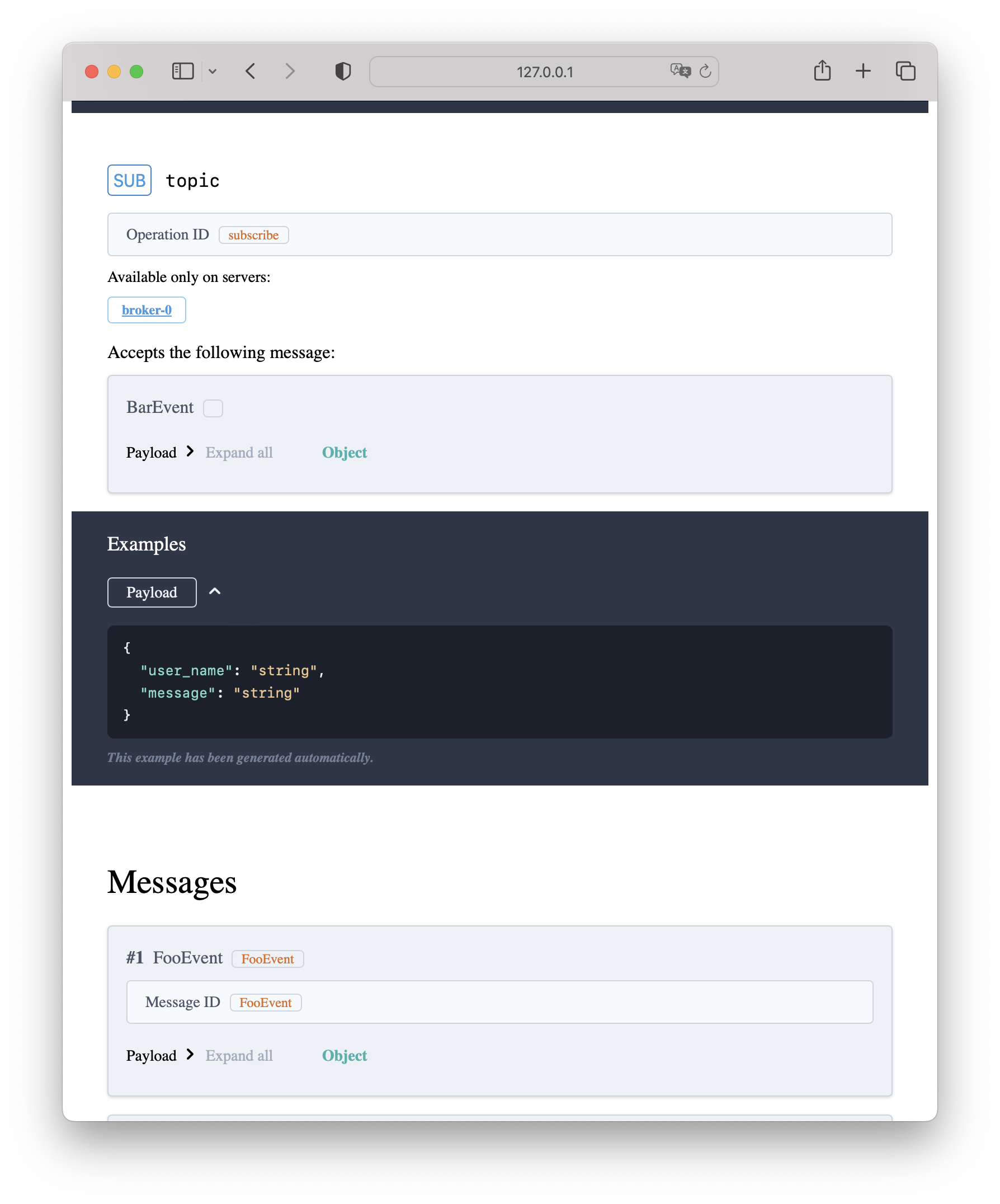
Restart your app. Now docs includes produced events as well: